


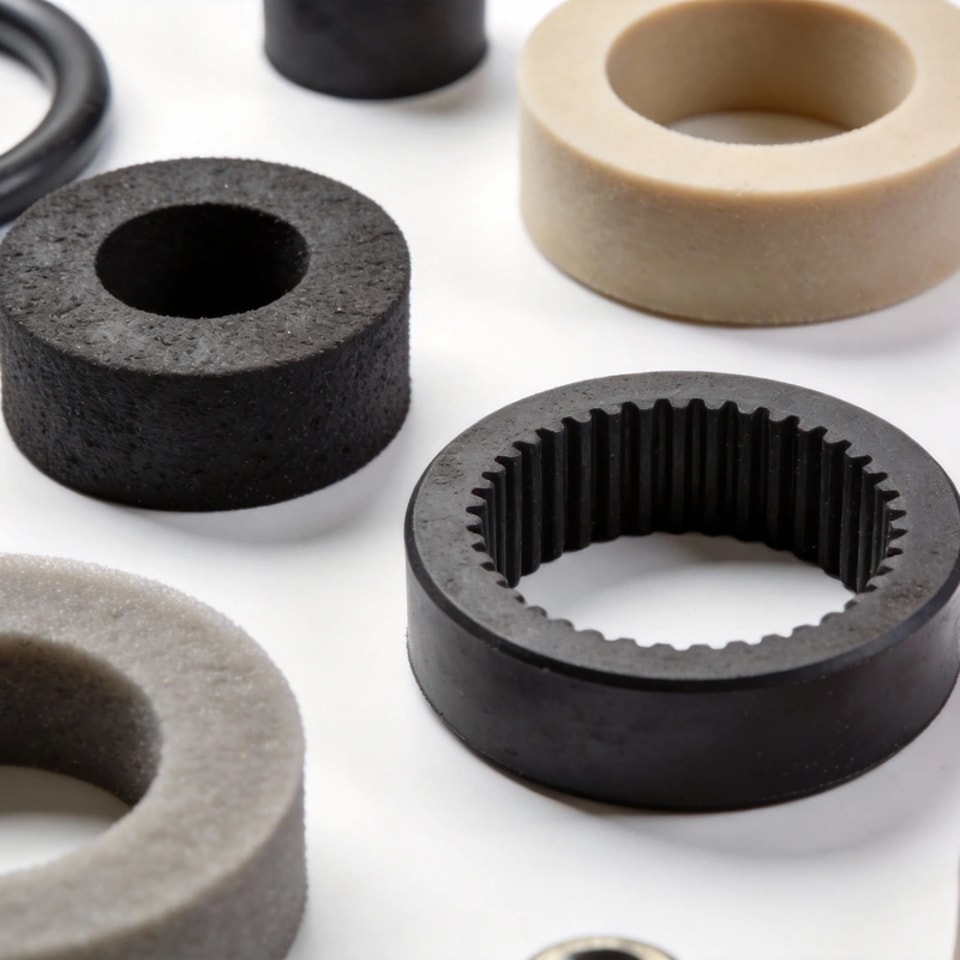
Understanding Shore Hardness: A Practical Guide to Durometer Scales
Shore hardness is the most commonly specified property for rubber and flexible plastic materials, yet it is frequently misunderstood or incorrectly applied. This practical guide clarifies durometer measurement principles and helps engineers specify the right hardness for their application.
Durometer Scales
- Shore A: Most common scale for rubber and flexible plastics. Range: 20A (soft gel-like) to 90A (hard rubber). Used for O-rings, seals, gaskets, grips, bumpers, and most elastomer components. Measured with a blunt indenter under 822g spring force.
- Shore D: For hard plastics and very hard rubber. Range: 20D (≈90A overlap) to 80D (rigid plastic). Used for hard hats, golf balls, rigid PVC, nylon, and HDPE. Measured with a sharp conical indenter under 4,536g spring force.
- Shore OO: For very soft materials. Range: 0OO to 100OO. Used for gels, foams, sponge rubber, and very soft silicone. Measured with a large hemispherical indenter.
Application Guide
| Hardness (Shore A) | Feel | Typical Application |
| 20-30A | Very soft, gel-like | Gel pads, soft grips, cushioning |
| 40-50A | Soft, flexible | Soft seals, medical tubing, wiper blades |
| 60-70A | Medium, standard rubber | O-rings, gaskets, tire treads, bumpers |
| 80-90A | Hard, rigid rubber | Rollers, hard seals, shoe soles, wheels |
Measurement Best Practices
- Specimen thickness must be ≥6mm (stack thin samples if needed) per ASTM D2240
- Take reading at 1 second (instantaneous) or 15 seconds (delayed) — specify which in your requirement
- Temperature affects readings: test at 23±2°C per standard conditions
- Average 5 readings taken at different locations, spaced ≥12mm apart
- Hardness tolerance: ±5 Shore A is standard industry practice for molded rubber parts
Common Misconceptions
- Shore A and Shore D are NOT interchangeable scales — "60D" is not the same as "60A"
- Hardness does not equal stiffness — two 70A compounds can have very different modulus values
- Hardness does not predict compression set, chemical resistance, or temperature performance
- Post-cure hardness may differ from initial readings by 2-5 points due to continued crosslinking
US FACTORY
US WAREHOUSES


